Meet Priya, a 34-year-old marketing manager in Bangalore. Every year, she spends hours gathering documents, calculating deductions, and worrying about mistakes. She wonders: “Why can’t the tax department just tell me how much to pay? They already have all my data.”
Then there’s Rajesh, a 45-year-old CA in Pune who’s been filing returns for clients for two decades. He’s seen the shift from paper forms to online filing, and now he’s watching AI take over routine tasks. “Will AI replace me?” he wonders.
Welcome to the future of taxation in India—where artificial intelligence (AI), machine learning, and automation are transforming how taxes are filed, processed, and audited. The Income Tax Department’s new “Taxpayer First” initiative has embraced technology to make compliance easier, faster, and more accurate.
In 2026, the tax landscape is radically different:
-
Pre-filled ITR forms with data from banks, stock exchanges, and employers
-
Annual Information Statement (AIS) capturing virtually all your financial transactions
-
Faceless assessments where AI scrutinizes returns without human intervention
-
Automated notices for mismatches, generated in real-time
-
Chatbots and AI assistants answering taxpayer queries 24/7
In this comprehensive guide, you’ll discover:
-
How AI is changing tax filing for individuals and businesses
-
The power of AIS and pre-filled returns – what they mean for you
-
Faceless assessment and appeal – the new normal
-
AI in GST compliance – automation in matching returns
-
Future trends – what to expect by 2030
-
How to adapt – thrive in the age of tax automation
-
Free tools to leverage AI for your own tax planning
Let’s explore the exciting future of taxation—and how you can benefit from it.
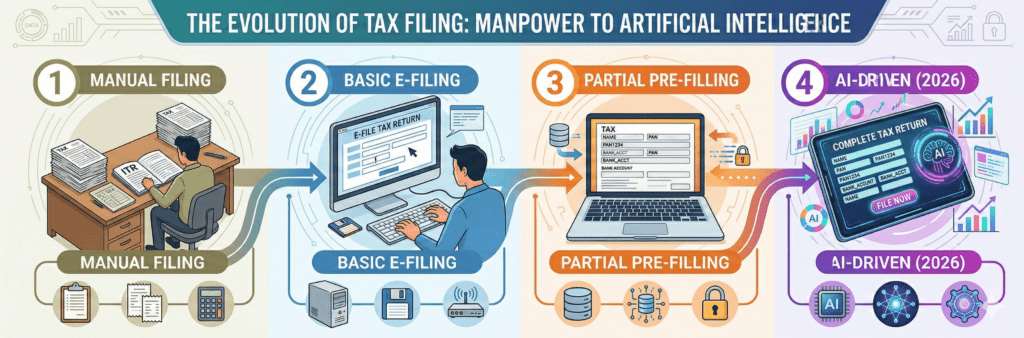
THE EVOLUTION OF TAX FILING IN INDIA
From Paper to AI: A Timeline
The Data Revolution
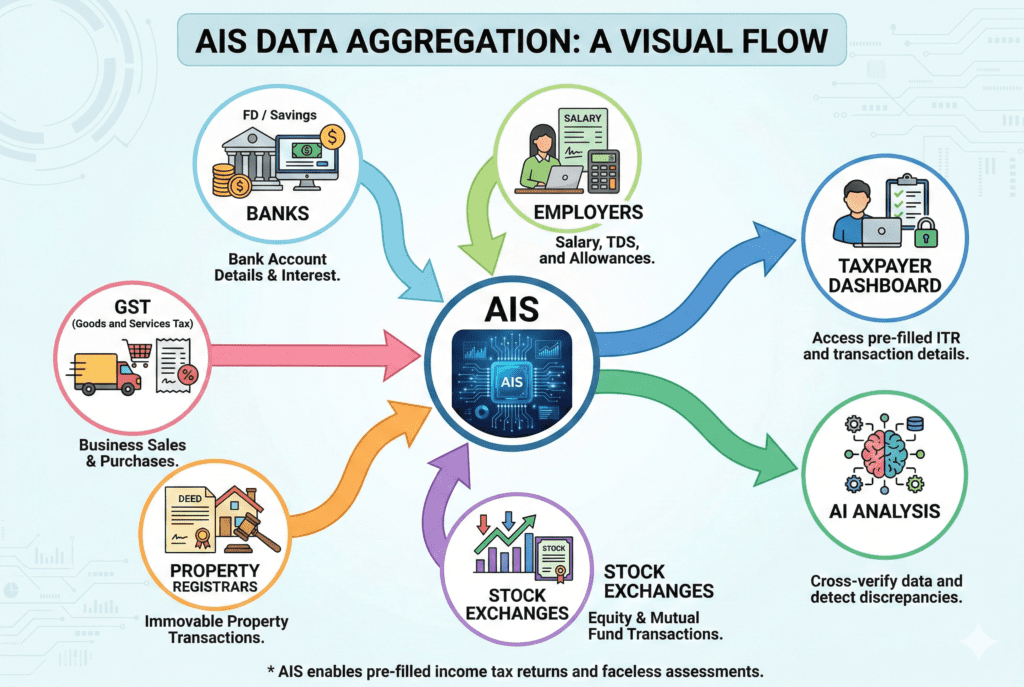
Today, the Income Tax Department receives data from multiple sources:
This data is aggregated into your Annual Information Statement (AIS) – a complete financial profile visible to both you and the tax department.
ANNUAL INFORMATION STATEMENT (AIS): YOUR FINANCIAL MIRROR
What is AIS?
The Annual Information Statement (AIS) is a comprehensive statement showing all your financial transactions reported to the Income Tax Department. It includes:
How AIS is Generated
Why AIS Matters for Taxpayers
How to Use AIS for Error-Free Filing
Pro Tip: Check your AIS before filing ITR. It’s your best defense against notices.

AI-POWERED PRE-FILLED ITR FORMS
How Pre-filling Works
When you log in to file your ITR for AY 2026-27, you’ll see that most fields are already filled:
The AI Behind Pre-filling
Example: Priya’s Pre-filled ITR
Accuracy and Responsibility
While AI pre-fills most data, the final responsibility is yours. Always:
-
Review all pre-filled entries
-
Add any income not captured (e.g., cash transactions)
-
Correct any errors
-
Verify totals match your records
FACELESS ASSESSMENT AND AI SCRUTINY
What is Faceless Assessment?
Introduced in 2021 and now fully operational, faceless assessment means:
-
No physical interface between taxpayer and assessing officer
-
Cases randomly allocated to officers anywhere in India
-
AI-based risk scoring determines which returns are scrutinized
-
All communication through online portal
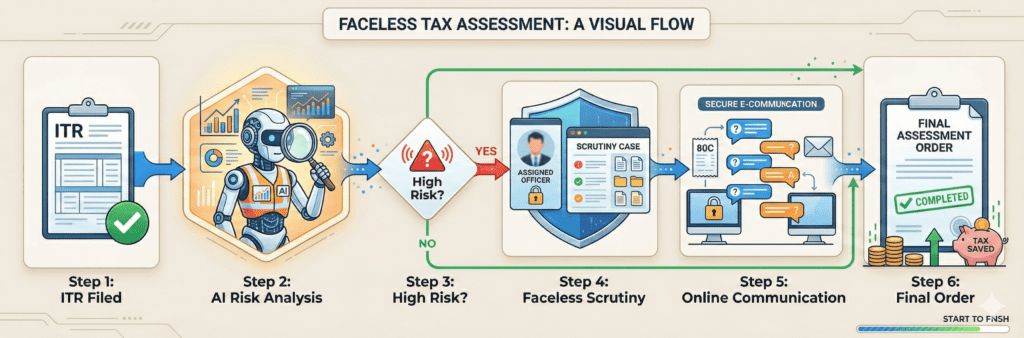
How AI Selects Returns for Scrutiny
The Assessment Process
Benefits of Faceless Assessment
AI IN GST COMPLIANCE
Automated Return Matching
The GST system now uses AI to:
Real-Time Compliance Alerts
Example: AI Detecting Fraud
Scenario: A trader claims ₹5 lakh ITC from a supplier who hasn’t filed returns for 6 months.
AI-POWERED TAX ASSISTANTS AND CHATBOTS
24/7 Taxpayer Support
The Income Tax Department now offers:
Third-Party AI Tools
Beyond government portals, private tools like India Tax Tools leverage AI to:
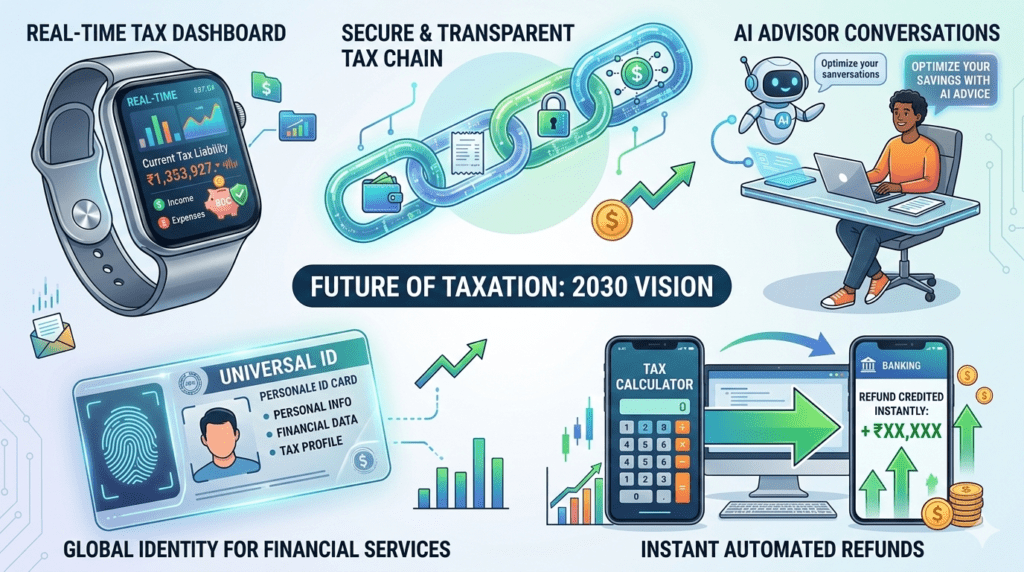
FUTURE TRENDS: TAXATION IN 2030
What to Expect by 2030
Impact on Taxpayers
Impact on Tax Professionals
HOW TO ADAPT TO THE AI-DRIVEN TAX FUTURE
For Individuals
For Businesses
For Tax Professionals
ETHICAL CONSIDERATIONS AND CHALLENGES
Privacy Concerns
Algorithmic Bias
Digital Divide
Solutions
FREQUENTLY ASKED QUESTIONS
Q1: Is my tax return data safe with AI systems?
Yes. The Income Tax Department uses enterprise-grade encryption and access controls. Data is anonymized for AI analysis. Your personal information is protected under Section 138 of the Income Tax Act .
Q2: Can AI make mistakes in my tax calculation?
AI systems are highly accurate but not infallible. You should always review your pre-filled return and AIS. If you find errors, you can file feedback online .
Q3: Will AI replace chartered accountants?
AI will automate routine compliance (data entry, basic calculations) but increase demand for strategic advisory, complex tax planning, and litigation support. CAs who embrace technology will thrive .
Q4: What is AIS and how do I access it?
Annual Information Statement (AIS) is a comprehensive statement of your financial transactions. Access it by logging into the income tax portal and navigating to “Services” > “AIS” .
Q5: How does AI select returns for scrutiny?
AI uses risk-based algorithms considering factors like income mismatches, unusual deductions, high-value transactions, and past compliance behavior. The exact formula is confidential to prevent gaming .
Q6: Can I talk to a human if I disagree with AI assessment?
Yes. Faceless assessment includes provisions for human review on request. You can file objections online, and a human officer will consider your case .
Q7: What is faceless assessment?
Faceless assessment means your return is scrutinized by an officer in a different city, with all communication online. There’s no physical interface, reducing corruption and harassment .
Q8: How accurate is pre-filled ITR data?
Pre-filled data comes from verified sources (banks, employers, stock exchanges) and is highly accurate. However, it may not include cash transactions or income not reported by third parties—you must add these manually .
Q9: Will AI help me save tax?
AI-powered tools like India Tax Tools can recommend optimal tax-saving investments and compare old vs new regimes to minimize your liability .
Q10: What happens if I ignore AI-generated notices?
Ignoring notices leads to penalties, interest, and potential prosecution. Always respond online within the given timeframe .
ACTIONABLE CHECKLIST: THRIVE IN THE AI TAX ERA
This Year (2026)
-
Link PAN with Aadhaar (if not already)
-
Download and review your AIS before filing
-
Correct any errors in AIS using online feedback
-
Use pre-filled ITR to save time
-
Verify all pre-filled data against your records
-
Add any missing income (cash, etc.)
-
Choose regime wisely using India Tax Tools’ Advanced Tax Calculator
-
File on time to avoid AI-triggered late fees
Ongoing Habits
-
Check AIS quarterly for accuracy
-
Maintain digital records of all transactions
-
Use tax planning tools year-round, not just at filing
-
Stay informed about AI-driven compliance changes
-
For businesses: reconcile GST monthly to avoid auto-suspension
For Tax Professionals
-
Invest in practice management software
-
Learn data analytics and AI tools
-
Focus on advisory and complex cases
-
Educate clients on AIS and pre-filled returns
-
Collaborate with tech platforms like India Tax Tools
CONCLUSION: EMBRACE THE AI-DRIVEN TAX FUTURE
The future of taxation in India is here—and it’s powered by AI and automation. For taxpayers, this means:
-
Easier filing with pre-filled returns
-
Greater transparency through AIS
-
Faster refunds with automated processing
-
Fewer errors with AI validation
-
Better compliance with real-time alerts
Your Role in This Future
- Stay informed – understand how AI affects your taxes
- Be proactive – check AIS regularly, correct errors early
- Use technology – leverage tools like India Tax Tools for planning
- File on time – AI doesn’t forgive delays
- Adapt and thrive – whether you’re an individual or professional
The machines are handling the data. You focus on the decisions.
Your Next Steps
-
Explore India Tax Tools – see how AI-powered calculators can simplify your tax life
-
Download your AIS today – know what the tax department knows
-
Share this guide – help others understand the future
-
Embrace the change – it’s making tax compliance better for everyone
Remember: AI in taxation isn’t about replacing humans—it’s about freeing us from drudgery so we can focus on what matters: growing our wealth, planning our future, and living our lives.
“The future of taxation is not about more taxes—it’s about smarter compliance. AI handles the data; you handle the decisions. Embrace the change, and let technology simplify your tax life.”
Disclaimer: This article is for informational and educational purposes only. Tax laws, AI implementations, and compliance requirements are subject to change based on government notifications. Please consult a qualified Chartered Accountant for advice tailored to your specific situation. The information provided is based on Budget 2026 announcements and current provisions as of February 2026. India Tax Tools calculators are free tools for estimation and should not be considered as professional tax advice.

 India Tax ToolsFebruary 26, 20269 Mins read13
 India Tax ToolsFebruary 26, 20269 Mins read13






Leave a comment